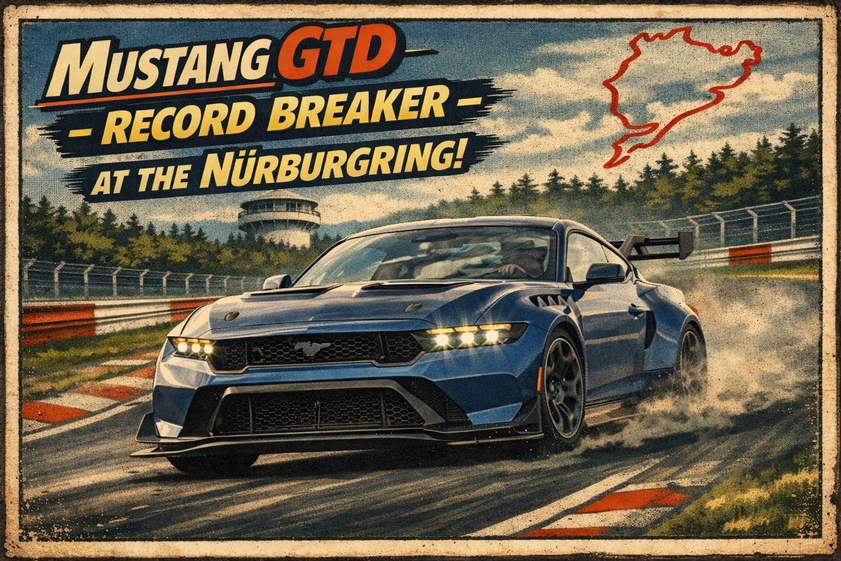
Is This a REAL Mustang? GTD Takes on the ZR1 at the Nürburgring
The latest Mustang GTD is stirring up the comments section, but most of those comments are missing the mark.
Other
 SVT_MAN
Estimated 8 min read
Published May 16, 2026
. Updated Jun 14, 2026.
SVT_MAN
Estimated 8 min read
Published May 16, 2026
. Updated Jun 14, 2026.
The Ford Mustang GTD just went to the Nürburgring Nordschleife and ran a 6:40.835 lap time, driven by factory driver Dirk Müller under Ford Performance and Multimatic support.
You might not believe it but you have to because you're looking right at it above in the YouTube embedded video.
This scorching time placed the Mustang GTD sixth overall in the Pre-Production / Prototype leaderboard, right in the middle of serious company.
You know the weird thing, though? It's that automotive enthusiasts aren't talking about the lap anymore. Instead, online automotive outlets are encouraging an environment where objectors can explain away the lap and justify why it "didn't count."
But I'm not going to do that - right away, anyway.
Instead, I first want to talk about the amazing engineering behind the car first.
The Car That Ran the Number
To understand what actually happened, you have to understand what changed on the car itself. This wasn’t another existing Mustang with a lucky lap. Instead, the GTD was actively developed into a sharper, more extreme machine specifically for this kind of performance. Power was increased through updated hardware and more aggressive calibration of the supercharged 5.2-liter V8, targeting output beyond 815 horsepower. We're talking about far more than a tune here.Beyond that, aerodynamics were also pushed further. The car builds on its Drag Reduction System (DRS), but for this configuration it added revised rear wing elements, secondary front dive planes, and rear carbon fiber aero discs.
The goal wasn’t just more downforce. Instead, it was usable downforce - maintaining balance at speed instead of chasing peak numbers.
Grip was also improved through a revised high-performance tire package, and weight came down through a series of incremental but meaningful changes: magnesium wheels, carbon bucket seats, lighter dampers, and other reductions that collectively matter when you’re chasing seconds at the Nürburgring.
In short, the formula isn't different from any other serious track-focused development program: weight reduction, grip improvement, and more power. The formula is simple but the implementation is not.
Yeah, but ...
Somehow instead of engaging with the lap time or the engineering behind it, a predictable online narrative took over almost immediately:“Yeah, but it’s built by Multimatic not Ford and it's not a Mustang.”And that’s where things stop making sense. The premise of this argument is framed like a disqualifier - as if outside engineering prowess automatically invalidates the result and the "Mustang" name.
Yet, it doesn’t.
What we're seeing here is that it’s just a convenient hook for engagement farming by social media provocateurs.
Online automotive media knows exactly what drives traffic: outrage, tribal loyalty, and brand conflict. It's frankly exhausting.
To media outlets, a Mustang beating expectations at the Nürburgring is somewhat interesting but it's not a strong enough story without an angle.
A story about a fast Mustang doesn't drive as many clicks as it could. So, instead, the narrative shifts to this: Multimatic built the car so it doesn't count as a Ford Mustang.
Deep down, the automotive media juggernauts know this is a nonsense take, but they do it anyway for a simple reason: this is fodder ripe for a comment section war between the Corvette and Mustang fan boys. And comments drive clicks and engagement.
If That’s the Standard, the Entire Industry Fails It
Where should we start with this whole "it must be built and engineered entirely by the manufacturer" argument?Well, let's start here: if “outside engineering involvement” is somehow the automatic disqualifier for it "counting," then a lot of respected performance history disappears instantly - not only from Ford's repertoire but GM's as well.
Ironically, we can look in GM's own storied Corvette history for one particularly ironic example: the 1990 Chevrolet Corvette ZR-1 is the obvious place to start. Do you remember the legendary engine? Its LT5 engine wasn’t developed in-house. Instead, it was co-developed with Lotus Cars and the motor was hand-built by Mercury Marine, who performed the precision machining of the aluminum blocks and heads as well as the complete assembly of the motor. Yet, back in 1991 we didn't hear calls from detractors for "it's not a Corvette" because GM hired some outside expertise. In fact, that car is still rightfully celebrated as one of the defining Corvettes of its era. The Corvette ZR1 was also one of my favorite to drive in the original Need for Speed.
Need another Corvette example? Well, let's look at the Callaway Corvette, which took things even further. In that case, we're talking about not just a tuned car but a car engineered by Callaway Cars and sold through Chevrolet dealerships under factory-sanctioned programs as a Chevy Corvette.
Nobody serious calls the Callaway version “not a real Corvette.” That's because it started life as a Corvette in Bowling Green, KY - and guess what: yep, it was still a Corvette after being modified by Callaway.
More recently in the Corvette history, we look at the extremely fast early 2000s Chevrolet Corvette Z06. Where exactly did that car gain its performance pedigree? The answer is that it owes a massive debt to the Chevrolet Corvette C5-R program, which involved a massive partnership with Pratt & Miller. Yes, that Pratt & Miller. That racing collaboration directly shaped the road car.
These aren’t edge cases. They’re central to Corvette history. And these aren't the only examples out there from GM or otherwise where manufacturers bring in outside experts.
How much Vertical Integration you want?
Let's be real - very few, if any - car companies are completely vertically integrated to the point where they build, engineer, and manufacture everything in house. (Ironically, Henry Ford was basically one of the pioneers of vertical integration and started out being his own supplier for almost everything - but that changed over time.) At some point this goes beyond vertical integration when we're chasing this kind of performance. Expecting a mass manufacturer to be an expert in everything performance is a ridiculous expectation.
Even so, if the GTD "isn't a Mustang" because of Ford's partners involved, what do we call it?
Do we need to start naming every supplier and engineering partner involved in the making of a given car?
Anyone see that Ford Multimatic Magna Tremec Brembo Bosch Michelin Mustang GTD?
What about that Chevrolet GM Brembo Michelin Bosch Tremec Pratt & Miller Corvette ZR1?
Catchy.
Well, I guess if those catch on, the Porsche 911 GT3 RS Manthey Performance Kit and the Mercedes-Benz S 65 AMG L Final Edition started it.
So What Is the Mustang GTD, Really?
Just like those Callaway Corvettes, the GTD starts life the same way any Mustang does: Ford’s Flat Rock Assembly Plant as a Mustang body-in-white.
From there, it remains a Ford-developed project under Ford Performance, before being handed to Multimatic for the kind of specialized transformation that traditional production lines simply aren’t designed to handle.
That includes advanced aero development, suspension architecture, and track-focused systems that take the platform far beyond normal road-car constraints.
What This Really Comes Down To
The Ford Mustang GTD didn’t suddenly become controversial because of engineering reality. It became controversial because of performance reality that ventured into territory that automotive outlets knew would make Chevrolet Corvette enthusiasts uncomfortable.After all, a Mustang just ran a Nürburgring time that puts it squarely in serious supercar territory, and the easiest way to process that isn’t to analyze the achievement. No - it’s to question the legitimacy of how it was built.
Legitimate Critiques Exist, though
If there is a legitimate point of debate, it’s the price tag. The GTD is an ultra-expensive, limited-production car. Considering the Mustang's calling card is affordable fun, this flips that formula on its head.But that’s also the point.
It was never meant to be a mass-market Mustang. Instead, it’s an experiment in how far the platform can be pushed when cost constraints are removed.
Everything else? A false premise from the start. Look no further than past Corvettes. From the 1991 Chevrolet Corvette ZR-1 to Callaway programs and race-derived Z06 development, leveraging outside expertise to achieve extreme performance is exactly how high-end cars have always been built.
There’s nothing unusual about it, and there’s certainly nothing illegitimate about it.
What is illegitimate is how quickly the conversation shifted away from the GTD lap time and toward manufactured controversy.
So when a Ford Mustang GTD runs a number that threatens hallowed ground like the Corvette, the story wasn't the lap time.
But it's not too late for that to change.
Your Turn
What do you think? Do you think the GTD’s Nürburgring run deserves more respect than the automotive outlet headlines gave it?
Post a Comment

Please Login To Your Account to comment.
User Comments
05/16/2026 @ 2026-05-16T21:01:43Z
Oh, please. Ford fan spinning another story. A one‑off race‑car aero and a price tag north of half a million isn’t a Mustang anymore.
You can’t compare that to a Corvette that’s actually sold to real people.
The ZR1 earned its stripes on the street and the track. Not by hiding behind marketing hype and Nürburgring lap times nobody can verify. Call me when Ford builds something that can beat a Corvette without turning it into a GT3 car.
05/21/2026 @ 2026-05-21T02:48:41Z
"Call me when Ford builds something that can beat a Corvette without turning it into a GT3 car."
Ring, ring...
05/23/2026 @ 2026-05-23T03:24:28Z
As a Chrysler guy, the Ford Mustang GTD is honestly painful to watch — and not because it’s bad. It’s the opposite.
Ford went all-in and built something completely unhinged in the best way possible. Meanwhile, over at Stellantis, we’re stuck watching the slow fade of what used to be a performance legacy.
Where is the modern Dodge Viper successor? Where’s the halo car that reminds people Chrysler brands can still be dangerous?
Instead, we get badge engineering, EV concepts, and “maybe someday” promises.
Ford just proved you can still build something raw, outrageous, and track-focused in 2025.
Chrysler fans aren’t mad at the GTD. We’re mad because we know our side should be doing this too… and just isn’t.
Anyway, I like this take even though I think the author takes himself too seriously.
Chevrolet Corvette ZR1 fans are in commentariat writing full investigative reports on why it “doesn’t count” like it’s a conspiracy documentary. Relax - it’s just fast. That's it. Fast cars mean we win. Ever see the mid to late 1970s? Yeah.